
Puppet theatre at home: short plays, the characters and how to build a stage
Three short plays to act out, a quick guide to the characters and ideas for turning a doorway, a table, a sofa or a cardboard box into a stage. For families, nurseries and anyone putting on a puppet show for the first time.
Puppet show scripts: three short plays to act out
Each play takes about five minutes, needs three or four characters and at most one prop you will find around the house. The lines are only suggestions: once you have read them through, improvise and let the children have their say.
Grandmother’s apple cake
Characters: Kasper, Grandmother, the Robber, the Policeman. Prop: a cake – a building block or a piece of card will do.
Kasper: “Tri-tra-trullala, Kasper’s here – hurrah! Is everybody here?” The children shout “Yes!”, and along comes Grandmother with a freshly baked apple cake. She leaves it outside the door to cool and asks Kasper to keep a close eye on it.
Kasper promises he will, yawns and falls asleep. Then the Robber creeps up. Now it’s the children’s turn: “Kasper, wake up!” Kasper jumps up, but the cake has gone. He asks the audience which way the Robber ran, but the Robber is long gone. So Kasper fetches the Policeman.
Together they set a trap for the Robber. Kasper shouts: “Grandmother has baked a second cake!” The Robber hears it and, because he can never get enough, comes back with the stolen cake still under his arm. The Policeman is already waiting and takes him away. Kasper gives the cake back to Grandmother, and she shares it with everyone.
The Crocodile and the sausages
Characters: Kasper, Seppel, the Crocodile. Prop: a string of sausages, for example a cord with a few knots in it.
Kasper and Seppel are going on a picnic. Seppel is carrying the sausages and is very proud of them. Behind him the Crocodile appears, the children shout “Seppel, behind you!”, Seppel turns round – and the Crocodile has already ducked out of sight. This happens three times, and each time the children shout louder.
The fourth time, the Crocodile snaps up the sausages and disappears with them in its mouth. Seppel wails, Kasper thinks hard. At last he calls out: “Crocodile, I know a lovely song!” Curious, the Crocodile comes back. Kasper sings it a lullaby, and all the children hum along. The Crocodile yawns, rests its head on the edge of the stage and falls asleep.
Quietly, Kasper and Seppel pull the sausages out of its mouth. When the Crocodile wakes up, it is sad and hungry. So Kasper invites it to the picnic: “Sharing is better than stealing!”
The magic word
Characters: Gretel, the Witch, Kasper. Prop: a magic wand – a wooden spoon will do.
The Witch is in a bad mood because nobody ever visits her. When Gretel walks past, the Witch waves her wand: “Hocus pocus, one, two, three, ribbit’s all you’ll say, you’ll see!” From then on, Gretel can only say “Ribbit!”
Kasper finds Gretel and can’t understand a word. The children tell him what has happened. He stomps off to the Witch: “Give Gretel her voice back at once!” The Witch shakes her head: “Not like that. What’s the magic word?” Kasper doesn’t know and asks the audience. The children shout: “Please!”
So Kasper says nicely: “Please!” This time it works: the Witch waves her wand, and Gretel can talk again. Her first words are: “Tomorrow we’ll all come round to yours for tea!” At last the Witch is getting visitors, and she is so pleased that she even says “thank you”.
Tips for a good show
Let Kasper open every play by asking whether everyone is there, even if he only joins the story later. That tells the children they are allowed to join in, and that is what a puppet show thrives on: warning, answering and humming along are all part of it.
Each character gets its own voice: high and quick for Kasper, deep and slow for the Robber, croaky for the Witch. Playing alone, you have two hands and so two characters at once; keep the others within reach below the edge of the stage. When three characters meet in a scene, one can briefly duck out of sight, or you can ask someone to help. The Crocodile play is easiest with two players.
Keep it short and play it again the next day: the second time round, the children know the story and shout along even louder. Sooner or later they will want to go behind the stage themselves. Then a child plays Kasper, and a grown-up plays a villain, such as the Crocodile or the Robber.
The cast of the three plays
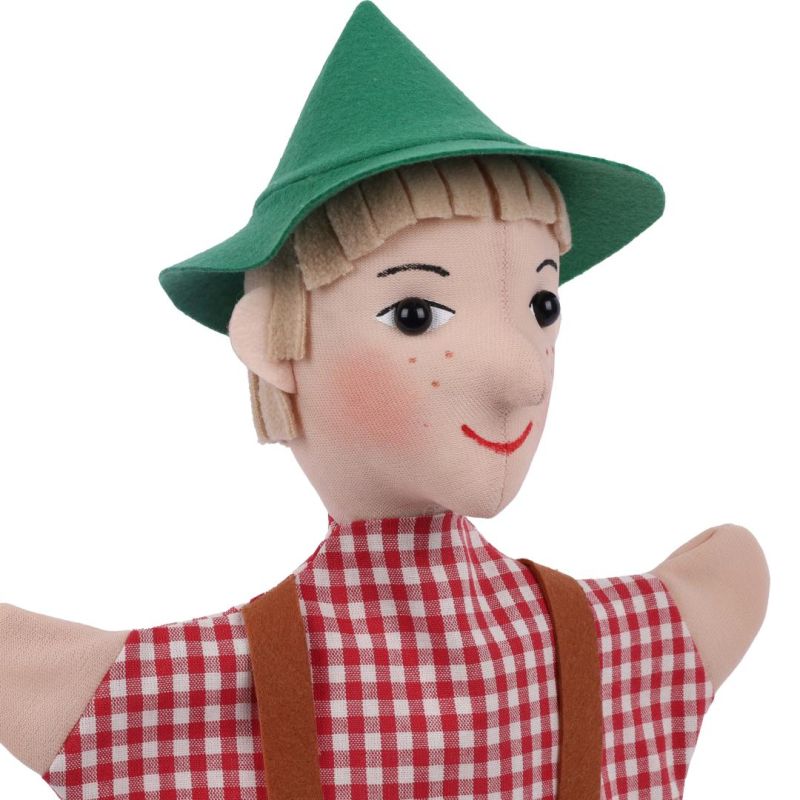
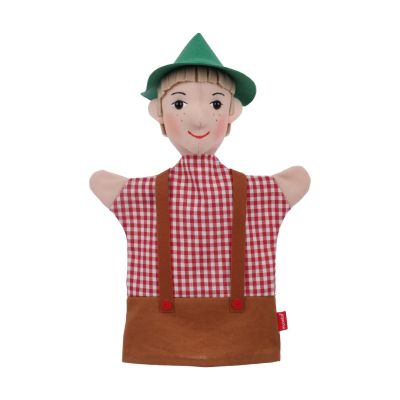
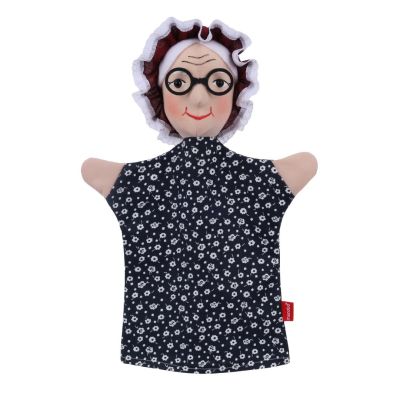
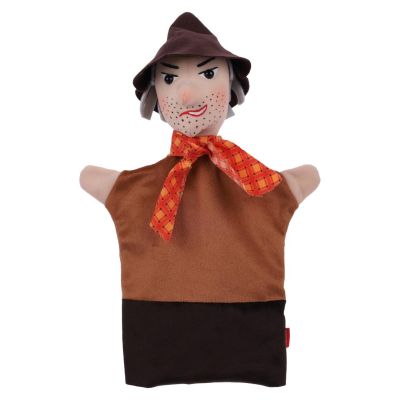
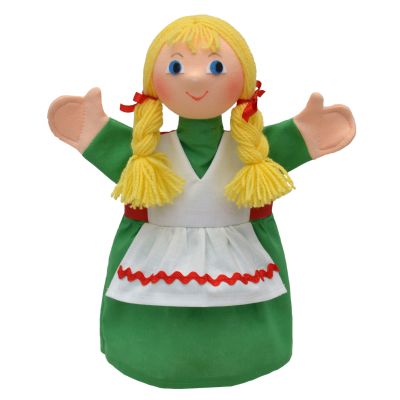
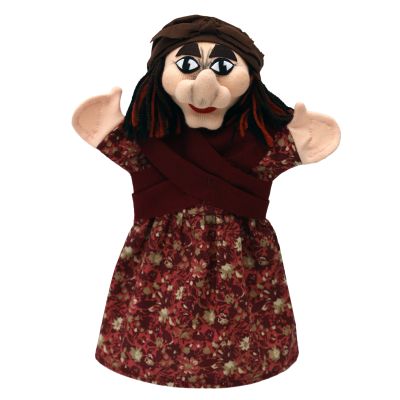
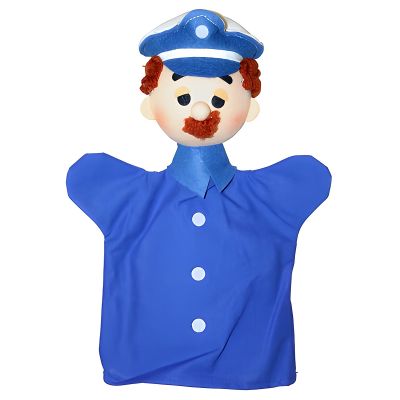
Kasper, Seppel, Grandmother and the Robber from the munabo ART series, plus Gretel, the Crocodile, the Witch and the Policeman.


Meet the characters, then build a stage
The roles in the traditional German puppet show have stayed largely the same for generations, and every character has its own job. A simple stage can be made from things you already have at home.
Kasper, Seppel, Gretel and Grandmother
Kasper is the hero of every play: curious, cheeky, sometimes a little lazy, but always on the side of the underdog. He talks straight to the audience and asks the children for advice. His name became well known through Viennese popular theatre in the late 18th century. In the 19th century, as a hand puppet, he travelled the fairgrounds with puppeteers. In Britain, his close relative is Mr Punch.
His best friend is Seppel, good-natured and a bit naive, which makes him perfect for scenes in which the audience has to warn him. In Bavaria and Austria, Kasper is called Kasperl, and in Bavaria especially, Kasperl and Seppel are an inseparable pair. In many plays Gretel is Kasper’s wife or sweetheart and often comes up with the idea that saves the day. And Grandmother bakes and cooks – many a story revolves around her cake or her sausages.
munabo ART →The Robber, the Crocodile, the Witch and the Policeman
Without a villain there is no story. The Robber is always after other people’s things, and he is easy to outwit because he can never get enough. Things get dangerous with the Crocodile: it eats whatever it can catch, sausages most of all, and pops up just when Kasper is looking the other way. The Witch casts spells and makes threats; in “The magic word” she is mainly lonely, which is why she is in a bad mood. In other plays, the Devil or a magician is the villain instead.
Keeping order is the Policeman’s job; in older plays he is also called a constable or gendarme. Kasper usually fetches him to help, and together they catch the culprit. The King, Queen, Prince and Princess belong to the fairy-tale plays: there the King sets the task, and Kasper solves it.
Punch and Judy puppets →A puppet theatre in a doorway
The quickest stage is a doorway. Fix a tension rod across the door frame – the kind used to hang curtains without drilling. Over it goes a cloth that reaches the floor: a bedsheet, a blanket or a length of fabric. A few clothes pegs keep it in place.
The rod and cloth now form the edge of the stage, which puppeteers call the playboard. The puppets perform above it, while the players stay out of sight behind it. The rod sits just above the heads of the kneeling or seated players, so it goes lower if the children are performing themselves. A pale cloth on a string behind the players, a little higher than the rod, makes a plain background. The tension rod only holds the cloth: check that it is firmly in place before each show, and make sure nobody leans on it.
Table, sofa or cardboard box
If the children are the puppeteers, you can manage without a rod. Behind a table with a blanket hanging down to the floor at the front, they disappear when they kneel down low, and the edge of the table becomes the edge of the stage. A sofa moved a little away from the wall works in a similar way: the children kneel behind it, and the backrest is the edge of the stage. You can also tip a table on its side so that the top faces the audience; the children then play over the upper edge. Make sure the table is stable and cannot topple over.
For something more permanent, build a stage from cardboard. A tall appliance box, such as one from a fridge, stands upright on the floor with the back left open. It gets a window at the front, set high enough for the kneeling children to stay hidden behind it; the bottom edge of the window is the edge of the stage, and the puppets come up from below. An adult cuts out the window with a craft knife, and the children paint the box. A tea towel on a string above the window becomes the curtain. For finger puppets, a shoebox is enough.
Advice and paying on invoice
We are happy to answer questions about the characters and about puppet shows by phone or through our contact form. Nurseries, schools, medical and therapy practices and care homes can also order on invoice; this payment option is activated once we have checked the customer account.


More characters for your own plays
For new stories: characters from other series, plus accessories.