
Learn ventriloquism: exercises and tips for beginners
Six exercises, from still lips and substitute sounds for B, P and M to eye contact with the puppet. Plus tips for your first show and advice on choosing a puppet.
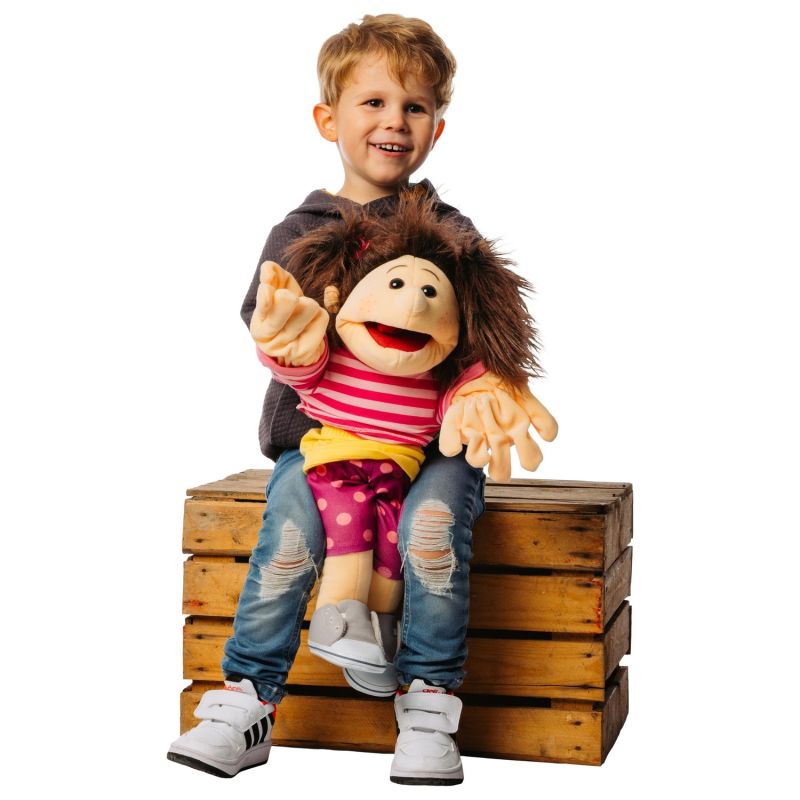
Six exercises to get you started
In ventriloquism, the voice doesn’t come from the stomach. You speak quite normally – the trick is that your lips barely move while the hand puppet draws every eye. Take as much time over each exercise as you need.
1. Relaxed lips, teeth slightly apart
Stand in front of a mirror and let your lips relax, as if you were smiling slightly. Keep a small gap between your teeth. Now slowly say simple words such as “hello”, “tea” or “night”: your tongue does the work, while your lips and jaw move as little as possible.
At first your speech will sound muffled. With a little practice, it becomes clearer.
2. Sentences without lip sounds
Before you tackle the tricky sounds, practise with sentences that do without B, P, M, F, V and W altogether. That way the puppet can already talk:
“Hello, children! It’s Lottie here.”
“It’s a nice sunny day today.”
“Look out, I’ll start giggling in a second!”
Repeat each sentence in front of the mirror until your lips no longer visibly move.
3. The tricky sounds: B, P, M, F, V and W
Normally your lips close for these sounds, or your lower lip touches your teeth. In ventriloquism they are replaced by similar sounds made with the tongue. Many people start like this: B becomes a soft D, P becomes a T, and M becomes an N or the ‘ng’ in “sing”.
For F and V, try a breathy sound with the tip of your tongue close to your upper teeth, similar to “th”. W starts from a quick “oo” sound. In a sentence, the audience hardly hears the difference because the context tells them which word to expect.
4. A voice of the puppet’s own
Your puppet needs a voice that is clearly different from yours: a little higher or lower, faster or slower, perhaps with a quirk such as a giggle. Try out several voices and stick with the one you can keep up for a long time without strain.
5. Mouth and voice in time
The illusion only works when the puppet’s mouth opens exactly when it speaks: once per syllable, no wider than necessary. Practise this first in your normal voice and concentrate only on the rhythm.
When you are speaking yourself, the puppet stays still or looks at you.
6. Eye line and timing
The audience looks where you look. So look at the puppet as soon as it speaks, and answer it as you would a real person, with little pauses, surprise or disagreement.
The punchlines belong to the puppet: it can be cheeky, smug or mouthy, while you play the straight man.
Trying ventriloquism with children
Children love trying ventriloquism as a game: who can say “Hello, it’s …” without moving their lips? With a mirror, each child can check for themselves; in pairs it becomes a little contest. When the children then add a hand puppet, everyone looks at the puppet, and small lip movements hardly show.
Your first show
Two or three minutes are enough for a first show: a greeting, a short argument with the puppet and a punchline to finish. Write the dialogue down beforehand and rehearse it aloud with the puppet until it is second nature. Family or friends make an ideal first audience.
Which puppet suits ventriloquism?
What matters most is a mouth that is easy to work. Whether you choose a person, an animal or a monster depends on your audience and your own style.
Human puppets with arms and hands
Traditionally, a ventriloquist works with a human figure sitting beside them or on their lap. Large characters with a movable mouth and movable arms and hands can gesture, scratch their heads or wave to the audience. Each product page lists which parts can be moved.
Large human puppets →Animals and monsters
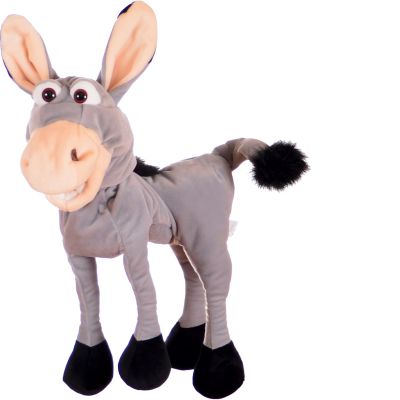
Not every ventriloquist’s puppet has to be a person. A donkey, a dog or a monster with a movable mouth works just as well, especially for a young audience. The key thing is that the mouth opens easily and evenly, so that every syllable gets a movement.
Woozle Goozle →Monsters →Advice and paying by invoice
We are happy to help you choose the right character by phone or through our contact form. Nurseries, schools, medical and therapy practices and care homes can also pay by invoice; we activate this option once we have checked your customer account.
Large human puppets for ventriloquism
These Living Puppets characters have a movable mouth as well as movable arms and hands.


Animals and monsters with a movable mouth
Often the first choice for a young audience: a donkey, a dog, a shark or a monster.



Explore more
Puppets for ventriloquism and another guide.