


For practitioners
Using a Hand Puppet for Communication and Language in the Early Years
A hand puppet gets children talking: it asks questions, gets things wrong and needs things explained. This page brings together ideas for using a hand puppet to support communication and language in nursery and reception. The tips come from everyday practice and go with the Puppet Play Workshop sets, but you can use them without the sets too.
Why a hand puppet gets children talking
Children talk to a hand puppet differently from the way they talk to adults. The puppet is smaller, doesn't know everything and needs help. That puts the children in the role of the ones who can explain.
Quieter children in particular will often whisper something in the puppet's ear before they speak in front of the group. The puppet is also allowed to make mistakes: if it says ‘the apple is blue’, the children will put it right all by themselves.
The puppet doesn't replace your own conversations with the children. It gives them a reason to start talking.
Introducing the hand puppet
Give the hand puppet a name and its own place, such as a basket where it ‘lives’. It comes out at a set time, for example at circle time, and it says goodbye again afterwards. This little routine helps the children get used to it.
The first appearances can be short: the puppet says hello, is amazed by something and disappears again. Only gradually does it start to tell the children more about itself.
Choose a voice for the puppet and stick to it.
Look at the puppet when it speaks. Then the children will look at it too.
After the session, don't just drop the puppet: put it ‘to bed’ or sit it back in its basket.
Rules and reminders come from you, not from the puppet.
Building vocabulary with word cards
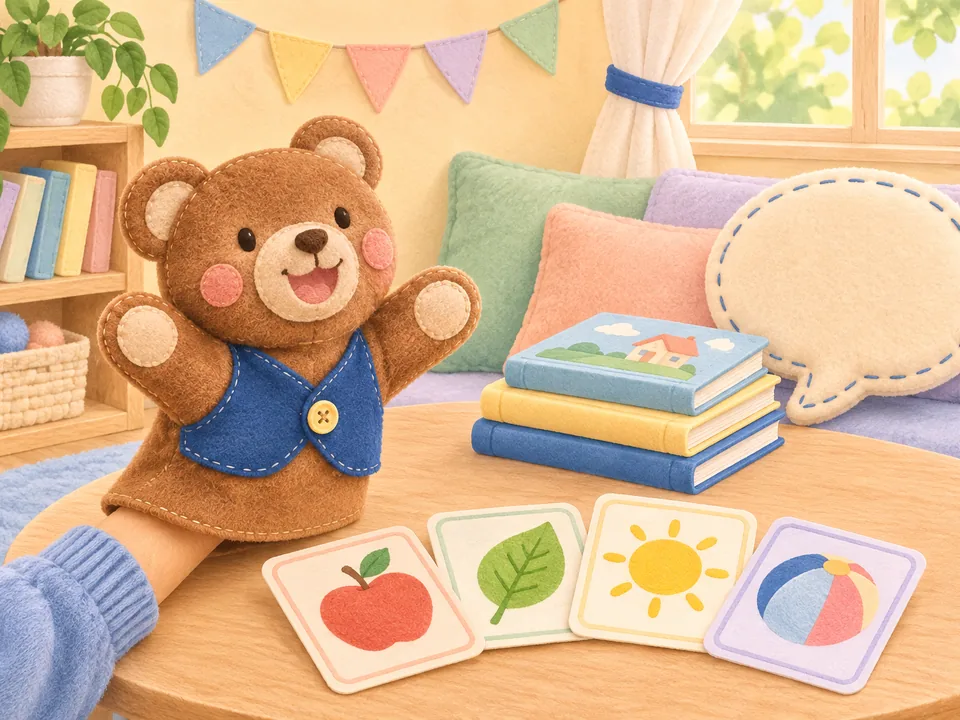
The puppet doesn't know a word and asks the children. That gives them a natural reason to say the word and repeat it. Show the real object first if you have it, and only then the word card. A leaf they can hold sticks in the memory better than a picture.
Use the word in a short phrase: ‘a hedgehog’, ‘look, a conker’. Come back to the same words over several days, with little games.
- What's missing? Lay out the cards, the children close their eyes and the puppet hides one.
- The puppet mixes up two words and the children correct it.
- The puppet whispers a word and the children find the matching card.
- Children who are already confident in English ‘teach’ the puppet new words.





Multilingual children and their families
A child's home language is not an obstacle but a foundation. Ask children or parents what a word is in their language. The puppet repeats it, gets it wrong and lets the children correct it. That way children see that their language counts in your setting.
You can print the workshop's word cards with a second language: choose the language on the word card page and the word will appear in that language next to the English one. Each set also comes with a letter for parents with the words and the finger rhyme, in English and several other languages.
Encourage parents to speak with their children at home in the language they know best. Some children say little in a new language at first and mainly listen. The puppet can offer them ways to answer without words, for example by nodding or pointing.
- Deutsch
- English
- Türkçe
- Українська
- العربية
- Polski
- Français
- Español
- Italiano
- Română
Finger rhymes and action rhymes for language
Finger rhymes combine language with rhythm and movement. Children often join in with the actions first and only later say single words, usually the rhyming word at the end of the line. These steps are a good start.
Speak slowly and clearly and repeat the rhyme several times. Vary it as you go: once loudly, once in a whisper, once as slowly as a snail. The hand puppet can introduce the rhyme or ask at the end which word rhymes with ‘tree’.
Common pitfalls with puppet play in the early years
Most stumbling blocks come from doing too much: too many words, too fast, too many questions. When the puppet waits calmly, the children say more.
- The puppet talks non-stop. Better: short sentences, then a pause.
- The puppet quizzes the children as if it were a test. Better: it wonders, guesses wrong and lets them explain.
- Mistakes are corrected head-on (‘That's not how you say it’). Better: the puppet repeats the child's sentence correctly, without telling them off.
- The puppet threatens or scolds. Then it loses the children's trust.
- The voice changes from one day to the next. Children recognise the character by its voice.
- After the session the puppet lies limp on the table, right in front of the children.
Observing and recording
Puppet play is a good chance to observe children's language, because many children talk more freely there than in other situations. Jot down a few quick notes afterwards.
These observations add to the observation and assessment your setting already does, and give you something to share at the next conversation with parents. They are not a diagnosis. If you are concerned about a child's speech and language development, talk to the parents and your setting's SENCo, and suggest that the parents speak to their health visitor or GP.
- Which children talk to the puppet on their own initiative?
- Does a child answer with single words or with whole sentences?
- Which new words does a child use in the days that follow?
- Does a child ask questions of their own?
Frequently asked questions
What kind of hand puppet works best for speech and language?
A hand puppet with a mouth or muzzle you can move works well, because it looks more alive when it talks. Whether it's an animal or a person matters less. What counts is that you enjoy playing the character and that it suits your group.
Do I need to be a ventriloquist?
No. The children know it's you talking and join in anyway. All that matters is that you look at the puppet when it speaks and give it a voice of its own.
Can I use a hand puppet with babies and toddlers?
Yes, with short appearances. The puppet says hello, shows an object and says one word to go with it. Finger rhymes with clear actions work especially well at this age.
Can the children play with the hand puppet themselves?
Yes. But it's worth keeping one special puppet just for the adult and giving the children other puppets for their own play. That way the puppet keeps its role in the daily life of the group.